

Repair mortars must balance workability, adhesion, dimensional stability, strength and durability. For dry-mix mortar manufacturers, selecting the right additive is therefore a formulation decision, not simply a matter of increasing air content or improving flow.
CARBOFEN NCX, developed by Polytrade, is a water-soluble, powdered natural resin-based additive with air-entraining activity in cementitious systems. Polytrade lists repair mortar among the potential applications of NCX. The next step for a specific repair-mortar product is to establish the appropriate dosage and verify the performance of the complete formulation.
What does an air-entraining additive do in repair mortar?
Air-entraining additives introduce small air voids into a fresh cementitious mixture. Depending on the formulation, controlled air incorporation may influence fresh density, consistency, spread, trowel feel and application behavior. However, the effect is formulation-dependent. Higher air content can also reduce hardened density and compressive strength, and may affect adhesion, absorption and other performance characteristics.
For repair mortars, the objective is not to maximize air. It is to determine whether a controlled air-void system provides a useful fresh-state benefit while keeping the hardened mortar within its performance specification.
Why evaluate CARBOFEN NCX in dry-mix repair mortar?
NCX is supplied as a water-soluble powder and can be evaluated by direct addition to the dry blend. This format may suit factory-produced dry-mix mortars where accurate dosing and repeatable blending are available. The additive may be assessed as part of a formulation containing cement, graded mineral aggregates, fillers and other functional additives.
NCX should not be treated as a replacement for every additive in a repair mortar. Cellulose ethers, redispersible polymer powders, water reducers, fibres and other components serve different functions. Compatibility and combined effects should be confirmed in the complete mix.
Which repair mortars should be evaluated first?
A practical development path is to start with non-structural, factory-produced dry-mix repair mortars, where the formulator can compare workability and air content against a control and then assess strength and bond. Use in structural repair products, including classes R3 and R4 under EN 1504-3, requires a more demanding validation programme against the applicable requirements for the finished product.
EN 1504-3 classifications apply to the finished repair product or system, not to an isolated additive. Adding NCX does not by itself establish compliance with a repair-mortar class or standard.
CARBOFEN NCX dosage: how to begin laboratory screening
There is no single dosage that can be recommended for every repair mortar. Cement type, binder content, aggregate grading, filler, polymer, cellulose ether, defoamer, mixing energy and target performance can all affect air incorporation. For this reason, dosage should be established through a controlled laboratory screening programme.
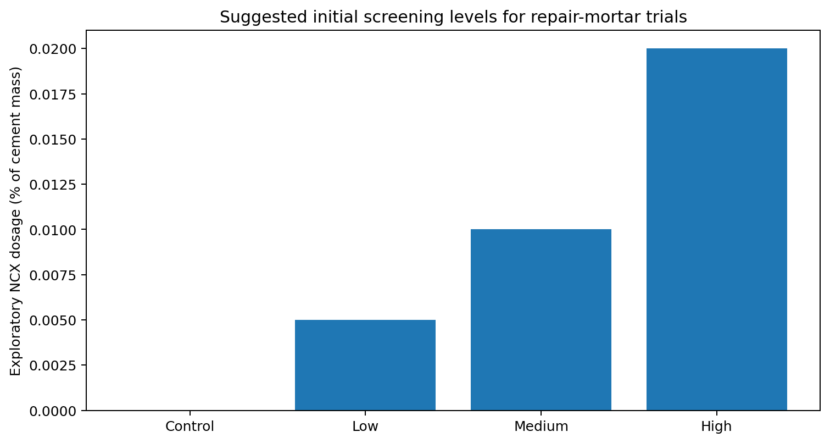
For an initial, conservative screening in a selected repair-mortar formulation, a laboratory may compare a control with exploratory levels of 0.005%, 0.010% and 0.020% NCX by mass of cement. These are proposed trial levels for investigation, not validated commercial recommendations for repair mortar. The current Polytrade technical team and the product TDS should be consulted before fixing a production dosage.
| Trial | NCX dosage (% of cement mass) | Purpose |
| Control | 0% | Baseline without NCX |
| A | 0.005% | Low-level exploratory trial |
| B | 0.010% | Intermediate exploratory trial |
| C | 0.020% | Higher exploratory trial |
Calculation example: at 0.010% by mass of cement, the NCX amount is 0.10 g per 1 kg of cement. At these low levels, use a suitable precision balance and consider preparing a dry premix with a measured portion of fine filler or dry sand to improve distribution.
The levels above are intentionally presented as a screening proposal. They should not be confused with a universal dosage range or extrapolated to another mortar without testing.
What do previous mortar data tell us?
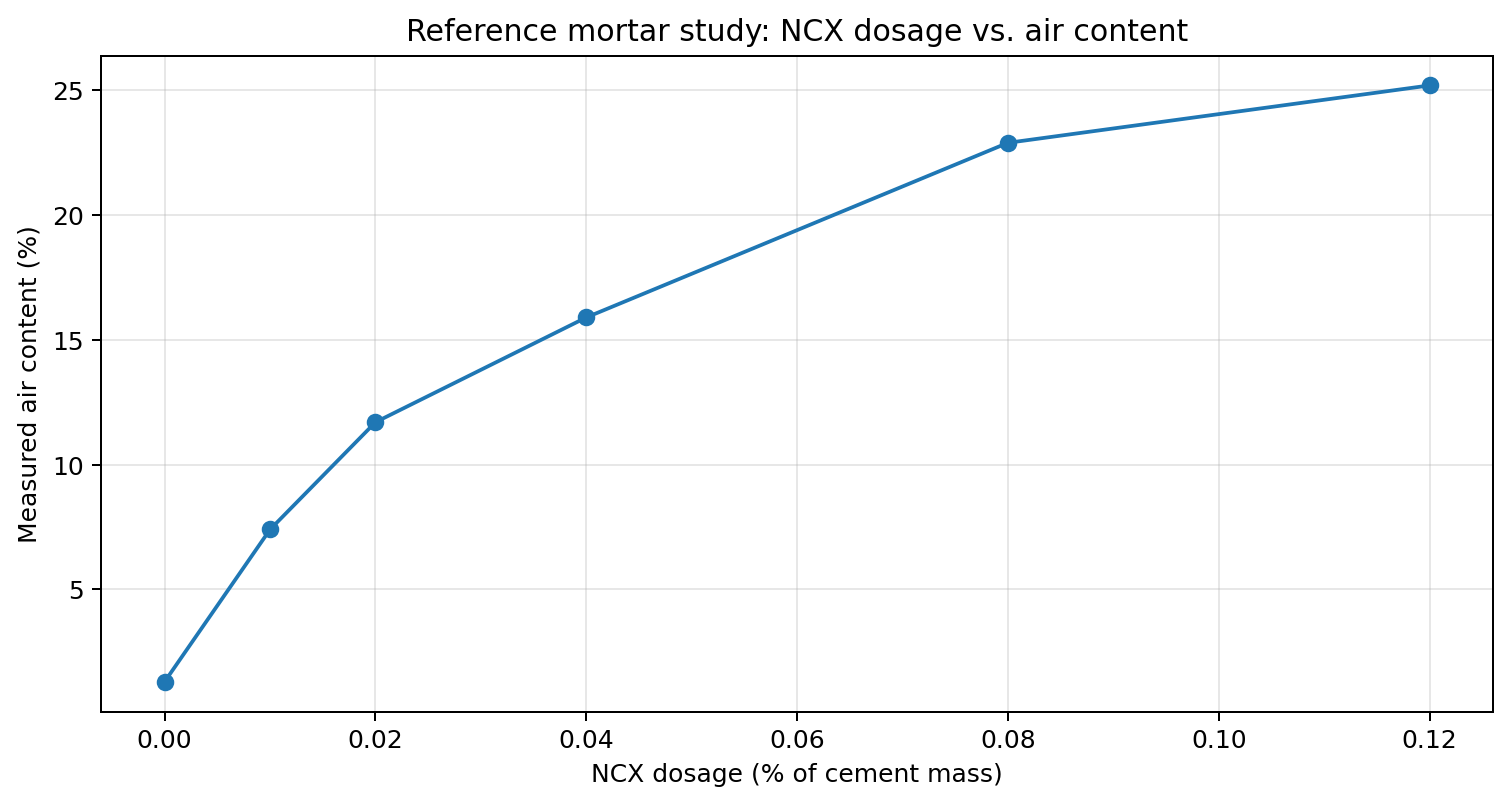
In a previous Polytrade mortar study, NCX dosage was varied and air content increased with dosage. The reported values were 1.3%, 7.4%, 11.7%, 15.9%, 22.9% and 25.2% at dosages of 0%, 0.01%, 0.02%, 0.04%, 0.08% and 0.12% of cement mass, respectively. These results illustrate that NCX can be highly active in air entrainment. They are reference data from a specific mortar formulation, not performance data for a repair mortar.
Figure 1. Reference results from a previous mortar study. These data are illustrative and must not be presented as repair-mortar validation.
Because air content can affect strength and other hardened properties, a higher dosage is not automatically better. For a repair mortar, the formulator should identify the lowest dosage that delivers a measurable fresh-state benefit without compromising the product specification.
How to add NCX to a dry-mix repair mortar
- Weigh accurately. Calculate dosage from the actual cement mass in the batch. Keep the formulation and raw-material quantities consistent across trials.
- Prepare a dry premix. At low dosage, blend NCX with a measured portion of fine mineral filler or dry sand before adding it to the full dry blend.
- Blend the dry ingredients. Use the established blending sequence and mixing time. Keep NCX protected from moisture.
- Add water consistently. Use the formulation’s normal mixing-water level for the first comparison. Do not change dosage and water content at the same time.
- Test the fresh mortar. Record air content where measurable, fresh density, flow or consistency, appearance and workability retention.
- Test the hardened mortar. Evaluate compressive strength, bond, shrinkage and absorption, plus any durability tests required for the intended use.
What should be measured?
| Property | Why it matters | Suggested comparison |
| Air content and fresh density | Shows the effect of NCX on air incorporation and density. | Control vs. each NCX dosage |
| Flow / consistency | Indicates fresh application behavior. | Same water content first; optimize later |
| Workability retention | Checks whether the mortar remains usable over the intended working period. | Initial, 30 min and 60 min where relevant |
| Compressive strength | Checks whether air incorporation compromises strength. | At ages required by the product specification, e.g. 1, 7 and 28 days |
| Bond strength | Critical for adhesion to the repair substrate. | Use the relevant method and substrate |
| Shrinkage and capillary absorption | Supports dimensional-stability and moisture-performance assessment. | Compare with product requirements |
| Durability | Required for the intended exposure and classification. | Apply relevant standard and customer specifications |
Compatibility with other repair-mortar additives
NCX may be evaluated alongside cellulose ethers (HPMC/HEMC), redispersible polymer powders (RDP/VAE), polycarboxylate-based water reducers, fibres, accelerators, retarders and defoamers. These ingredients have distinct functions, and their interactions can change air content, flow, setting, bond and strength. A defoamer, in particular, may counteract air entrainment. Compatibility must be established experimentally rather than assumed.
A practical go/no-go decision
Continue development when the trial shows a repeatable and useful fresh-state benefit while all required hardened properties remain within specification. Reduce dosage or adjust the formulation if air content is excessive, strength or bond falls below target, or workability retention becomes unacceptable. Do not recommend NCX for a particular repair mortar if the complete product fails its required performance criteria.
Conclusion: a formulation-led approach to repair mortar
CARBOFEN NCX is a potential natural resin-based air-entraining additive for selected dry-mix repair mortars. Its powdered format allows evaluation through direct dry blending, and previous mortar data demonstrate that dosage can strongly influence air content. The key is controlled optimization: establish a suitable dosage for the specific formulation and verify fresh properties, strength, bond and durability before making application claims.
If you manufacture cementitious repair mortars, contact Polytrade to discuss a laboratory evaluation of CARBOFEN NCX, define the target performance and plan a controlled comparison against your current air-entraining additive.
FAQ: CARBOFEN NCX in repair mortar
Can CARBOFEN NCX be used in repair mortar?
Polytrade lists repair mortar among potential NCX applications. A specific repair-mortar formulation must be tested before performance or dosage claims are made.
What is the recommended NCX dosage for repair mortar?
There is no universal validated dosage for all repair mortars. A proposed initial lab screen is 0.005%, 0.010% and 0.020% by cement mass, alongside a control. Confirm the range with Polytrade and validate the finished mortar.
Can NCX be added directly to dry-mix mortar?
NCX is a water-soluble powder and can be evaluated by direct addition to the dry blend. At low dosage, a premix with a measured portion of fine filler or dry sand can help improve distribution.
Does more air always improve repair-mortar performance?
No. Air may influence workability and density, but excessive air can reduce strength and affect bond or absorption. The target is controlled air content within the product specification.
Can NCX be used in structural R3 or R4 repair mortar?
Only after the complete mortar has been tested against all applicable requirements. NCX alone does not confer EN 1504-3 compliance.
Does NCX replace HPMC or RDP?
Not as a general rule. HPMC/HEMC and RDPs perform different functions and should be treated as complementary formulation components unless specific test data support a different conclusion.