

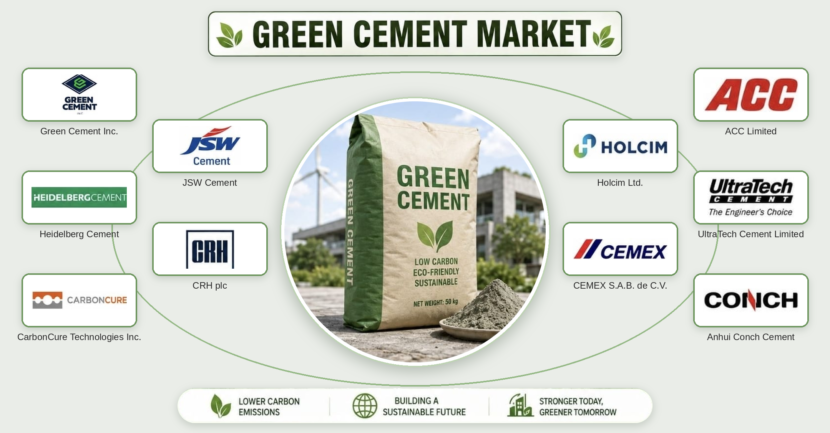
GREEN ADDITIVES FOR GREEN CEMENT
GREEN CEMENT DESERVES GREEN ADDITIVES
The cement industry is changing.
Across the world, cement manufacturers are developing lower-carbon products by reducing clinker content, increasing the use of supplementary cementitious materials, incorporating calcined clay and recycled materials, improving production efficiency, and exploring carbon capture technologies.
Holcim, for example, positions ECOPlanet as its global range of low-carbon cement, with products starting at 30% lower CO₂ emissions compared with standard cement. Its calcined-clay technology has also been used to produce cement with significantly lower CO₂ emissions. (Construção Sustentável | Holcim)
Heidelberg Materials has established evoBuild as a global portfolio for low-carbon and circular cement, concrete, aggregates and asphalt, with its low-carbon products required to achieve at least a 30% CO₂ reduction against defined reference values. (Heidelberg Materials)
This movement is creating a new question for the construction materials industry:
If cement is becoming greener, shouldn’t the additives used to manufacture and apply it evolve as well?
At Polytrade, we believe they should.
Green Cement Deserves Green Additives
What Is Green Cement?
Green cement, also referred to as low-carbon cement, generally describes cement products developed to reduce their environmental impact, particularly their embodied carbon.
There is no single technology behind green cement. Producers are pursuing different approaches, including:
- reducing clinker content;
- using supplementary cementitious materials, or SCMs;
- incorporating calcined clay;
- increasing the use of limestone and other alternative mineral components;
- incorporating recycled materials;
- improving energy efficiency;
- using alternative fuels;
- developing carbon capture and storage technologies;
- developing alternative cement chemistries.
Heidelberg Materials, for example, describes composite cements as combinations of clinker, SCMs and other additives that can significantly reduce the proportion of energy-intensive Portland cement clinker. (Heidelberg Materials)
This evolution is changing more than the carbon footprint of cement.
It is also changing cement chemistry and concrete performance.
And that makes additive technology increasingly important.
Green Cement Is Only One Part of the Equation
A cement plant does not operate in isolation.
The cement eventually becomes part of:
Cement → Concrete → Ready-Mix → Pumping → Placement → Finished Structure
At every stage, chemistry and formulation influence performance.
When cement formulations change, producers and formulators may need to reconsider:
- water demand;
- workability;
- rheology;
- air entrainment;
- air-bubble stability;
- setting behavior;
- pumping;
- strength development;
- water retention;
- durability;
- transportation and workability retention.
This means that the transition toward lower-carbon cement also creates an opportunity to rethink the additives supporting the cement and concrete value chain.
Green Cement deserves Green Additives.
What Are Green Additives?
The term Green Additives should not simply mean that an additive is marketed as environmentally friendly.
A more meaningful approach is to consider:
What is the origin of the raw material?
What does the additive replace?
What performance does it deliver?
Can it support lower-impact formulations?
Can renewable or bio-based raw materials be incorporated into the additive technology?
This is where natural resin technology can become part of the conversation.
Natural Resin Technology for Green Additives
Polytrade develops natural resin technologies based on renewable, plant-derived raw materials for applications across construction chemicals.
The Carbofen® portfolio includes natural resin technologies for concrete and mortar admixtures, including powder and liquid formats. Carbofen Admix, for example, is a plant-based aqueous resin solution developed for concrete admixture formulations, while Carbofen NCX is a water-soluble, plant-based powdered natural resin for concrete and mortar applications. (Polytrade)
This creates an opportunity to introduce a different concept to the construction industry:
GREEN ADDITIVES FOR GREEN CEMENT
Rather than looking only at the carbon footprint of cement, we can look at the entire formulation ecosystem.
From Cement Additives to Concrete Admixtures
The opportunity extends across two connected levels of the value chain.
- Green Additives for Cement
Natural resin technology can be evaluated as a functional raw material in the formulation of additives used in cement manufacturing and cement performance solutions.
Depending on the formulation and application, natural resin-based technologies can contribute to properties associated with:
- air entrainment;
- particle interaction;
- flow and handling;
- formulation flexibility;
- cement additive performance.
This is particularly relevant as cement manufacturers develop new formulations containing lower clinker levels and alternative cementitious materials.
The objective is not simply to replace one raw material with another.
It is to ask:
Can renewable raw materials become part of the chemistry supporting the next generation of cement?
- Green Additives for Concrete and Mortar
The same philosophy can continue after cement leaves the cement plant.
Polytrade’s Carbofen technologies are used in concrete and mortar admixture formulations where controlled air entrainment, workability, plasticity, water reduction and other performance characteristics are required.
Carbofen Admix, for example, is designed to incorporate small, stable air bubbles into concrete, supporting workability and other performance characteristics. Polytrade reports compliance with ASTM C260 for its air-entraining concrete admixture application. (Polytrade Chem Solutions)
Carbofen NCX is a water-soluble natural resin powder that can be used in concrete and mortar formulations. Polytrade describes applications including air entrainment and plasticization in cement-based mortar, as well as air entrainment in concrete. (Polytrade)
For mortar applications, Carbofen Air+ provides natural resin technology with air-entraining and plasticizing properties. (Polytrade)
The result is a broader concept:
Green additives should not stop at the cement plant.
They can continue through:
Cement
↓
Concrete
↓
Mortar
↓
Ready-Mix
↓
Pumping
↓
Jobsite
Green Additives for Ready-Mix Concrete
Consider what happens after concrete is produced.
A modern ready-mix concrete system may need to maintain its characteristics while traveling from the batching plant to the construction site, during discharge, pumping and placement.
The additive system therefore plays an important role in managing fresh concrete properties.
Depending on the formulation, this can include:
Workability
Helping concrete remain workable and easier to place.
Flowability
Supporting the movement and placement of the concrete.
Pumpability
Helping the concrete move efficiently through pumping systems.
Air Entrainment
Creating a controlled system of small air bubbles where air entrainment is required.
Air Stability
Supporting a stable and well-distributed air system.
Workability Retention
Helping maintain desired fresh-state characteristics during transportation and handling.
Polytrade’s natural resin-based technologies are developed for these types of formulation challenges across concrete and mortar applications. (Polytrade Chem Solutions)
Why Natural Resin?
The construction industry is increasingly examining not only the performance of chemical additives, but also the origin of their raw materials.
Carbofen is based on natural, plant-derived resin technology.
This creates an alternative approach to conventional additive chemistry:
Fossil-based / conventional raw materials
versus
Renewable / plant-derived raw material technologies
The goal is not to claim that a natural raw material automatically makes a formulation low-carbon.
That requires appropriate environmental data and lifecycle assessment.
Instead, the opportunity is to introduce renewable raw material technology into an industry increasingly focused on reducing environmental impact throughout the construction value chain.
Green Cement + Green Additives = A More Complete Approach
The future of sustainable construction cannot be defined by one material alone.
It involves an interconnected system.
Green Raw Materials
Renewable and alternative raw materials
↓
Green Additives
Natural and bio-based additive technologies
↓
Green Cement
Lower-carbon cement formulations
↓
Green Concrete & Mortar
Performance-optimized cementitious materials
↓
Greener Construction
More responsible construction solutions
This is the philosophy behind:
GREEN ADDITIVES FOR GREEN CEMENT
The Chemistry Behind the Green Cement Transition
The industry is already demonstrating that lower-carbon cement can require different material combinations.
Holcim’s calcined-clay cement initiatives are one example. Its ECOPlanet portfolio includes calcined-clay-based cement, with one French operation designed to produce cement with 50% lower CO₂ emissions compared with standard CEM I. (Construção Sustentável | Holcim)
Heidelberg Materials similarly highlights composite cement systems using clinker together with SCMs and other materials to reduce clinker content. (Heidelberg Materials)
These developments demonstrate an important principle:
Reducing clinker changes the formulation. Changing the formulation changes the chemistry. Changing the chemistry can change the requirements for additives.
That creates a new field of opportunity for additive developers and raw-material suppliers.
Polytrade: Natural Resin Technology Across the Value Chain
Polytrade’s Carbofen portfolio provides natural resin technologies in different physical forms and formulation platforms.
Carbofen Resin
Natural resin technology available as a powder and used as a raw material for applications including concrete and mortar admixtures. (Polytrade)
Carbofen Admix
Plant-based aqueous natural resin solution for concrete admixture formulations, with air-entraining and workability-related applications. (Polytrade)
Carbofen NCX
Water-soluble, plant-based powdered natural resin for concrete and mortar formulations, including dry-mix applications. (Polytrade)
Carbocrete
A natural-resin-based technology developed for cementitious systems, combining natural resin with lignin-enhanced chemistry. (Polytrade Chem Solutions)
Carbofen Air+ and AIR Mortar+
Natural resin-based technologies for mortar formulations, supporting air entrainment, plasticity and related fresh-mortar properties. (Polytrade)
Together, these technologies allow Polytrade to approach sustainability not as a single product characteristic, but as a formulation strategy.
A New Question for the Cement Industry
The industry has already asked:
How can we make cement greener?
The next question can be:
How can we make the chemistry around cement greener too?
And then:
How can we extend that philosophy from cement to concrete and mortar?
This is where the concept of Green Additives becomes relevant.
Green Cement Deserves Green Additives
A lower-carbon cement is an important step toward more sustainable construction.
But the construction value chain is much larger than the cement itself.
Raw materials matter.
Additives matter.
Admixtures matter.
Concrete formulation matters.
Mortar formulation matters.
Transportation and placement matter.
Performance and durability matter.
At Polytrade, we believe that the transition toward greener construction should include the chemistry supporting cement, concrete and mortar.
Our natural resin technologies provide a plant-derived alternative for additive and admixture formulations, connecting renewable raw material technology with the performance requirements of modern cementitious materials.
From Cement to Concrete: Green Additives Across the Entire Value Chain.
GREEN ADDITIVES FOR GREEN CEMENT.
GREEN CEMENT DESERVES GREEN ADDITIVES.