

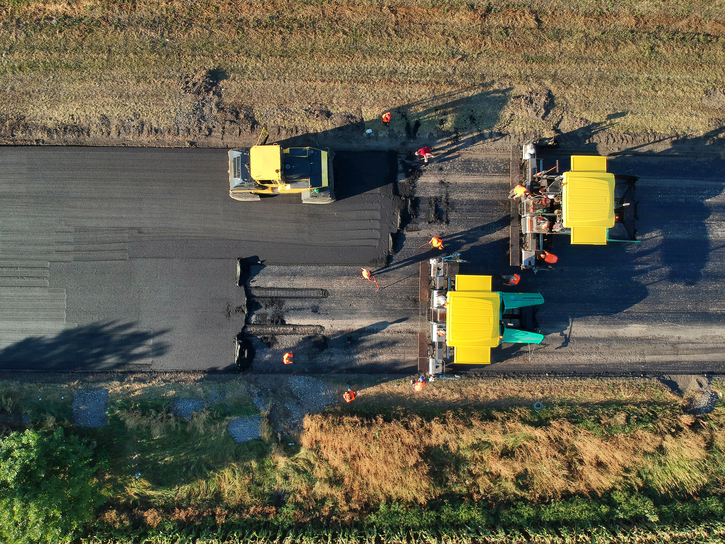
The use of hard penetration grade bitumen—such as 40/50, 30/40, or even lower penetration numbers—has grown significantly in applications where pavement durability and resistance to heavy loads are essential. While these binders offer exceptional performance in the field, they also introduce complexity during emulsification. Their high viscosity and strong internal cohesion make droplet break-up more difficult, increasing the demands on the mill, the emulsifier, and process control.
This is exactly where Emulsifen G10000 provides a technical advantage. As a liquid, water-soluble anionic emulsifierwith 45–49% active content, G10000 simplifies soap preparation and delivers the strong surface activity required to stabilize hard penetration bitumen in Slow-Set (SS) emulsions. Its high alkalinity and consistent performance across multiple bitumen sources make it a reliable option in challenging production environments.
Why Hard Penetration Bitumen Is More Difficult to Emulsify
When working with harder grades, producers face several inherent challenges. These bitumens exhibit higher viscosity, even at typical emulsification temperatures, which increases resistance to droplet formation in the colloid mill. Their cohesive nature also makes the emulsion more sensitive to soap pH, emulsifier concentration, and water quality.
Any imbalance in these variables—insufficient shear, improper pH, or low emulsifier strength—can quickly lead to issues such as large droplets, free oil, skin formation, or excessive sieve residue.
Because of this, emulsifiers with strong anionic activity and stable pH control, like Emulsifen G10000, are essential for achieving predictable, uniform, and stable emulsions with hard penetration grades.
The Role of pH and Shear in Successful Emulsification
Maintaining the correct pH is one of the most important factors when producing emulsions with hard bitumen. The emulsifier must be fully ionized to form a protective layer around the droplets. With Emulsifen G10000, the soap solution typically reaches a pH between 11.7 and 12.0, an ideal zone for SS emulsions produced with harder grades.
Shear also plays a central role. Because the droplets resist break-up, the mill must operate at higher rotation speeds, often above 3000 rpm in full-scale production and 7500–9000 rpm in laboratory tests. Bitumen temperatures must remain high enough to reduce viscosity—usually in the 120–140°C range—while the emulsion outlet temperature is commonly kept between 80 and 90°C.
When these parameters align, droplet formation becomes consistent, and the stability of the emulsion improves dramatically.
Preparing the Soap with Emulsifen G10000
One of the practical advantages of Emulsifen G10000 is that no heating is required during dilution. The soap is prepared by adding water under agitation, slowly introducing the emulsifier, and completing homogenization over 45–60 minutes. This reduces both energy consumption and preparation time.
After dilution, the pH can be adjusted as needed. When required, the working pH of G10000-based soap solutions can be increased up to 13.5, offering additional flexibility when working with particularly hard bitumen grades or when enhanced anionic strength is required.
Recommended Adjustments for Emulsifying Hard Grades
To achieve the best results with hard penetration bitumen, producers generally make small but meaningful adjustments to the process. Increasing shear energy, reducing mill gap, or lowering feed rate often leads to better droplet formation. Another common approach is to slightly increase the soap concentration or prepare a more concentrated soap solution within the recommended range.
Water quality is another important factor. High hardness or excess salts may interfere with the emulsifier’s performance. For this reason, potable water with low mineral content is strongly recommended.
Typical Formulation Example
For an SS-60 emulsion produced with Emulsifen G10000, a typical 1000 kg batch includes approximately:
-
412 kg Emulsifen G10000 soap solution
-
588 kg hard penetration bitumen (40/50 or 30/40)
When emulsifying harder grades, plants often increase the soap proportion by 2–5% to improve droplet size control and reduce sieve residue.
How to Identify and Correct Common Issues
Production challenges tend to follow predictable patterns when working with hard grades. Large droplets usually point to insufficient shear or bitumen temperatures that are too low. Free oil often results from incorrect pH or inadequate emulsifier concentration. High sieve residue typically indicates that the bitumen was not heated enough or that shear energy was limited due to mill gap or equipment condition.
Because Emulsifen G10000 offers stable alkalinity, strong anionic activity, and fast dispersion, it helps minimize many of these common issues while supporting greater batch-to-batch reproducibility.
Why Emulsifen G10000 Is an Ideal Choice for Hard Penetration Bitumen
Using a high-strength, easy-to-handle emulsifier can dramatically reduce production variability with hard grades. With G10000, producers benefit from:
-
simplified soap preparation with no heating required
-
more reproducible batches
-
improved emulsion stability
-
reduced sieve residue
-
greater flexibility in pH and concentration adjustments
For any plant working with 40/50, 30/40, or harder bitumen, Emulsifen G10000 provides technical reliability, operational efficiency, and consistent performance.
Conclusion
Producing Slow-Set emulsions with hard penetration bitumen is challenging, but entirely manageable with the right emulsifier. Emulsifen G10000 combines high anionic strength, excellent solubility, stable pH, and robust performance under demanding conditions. When paired with proper mill shear, controlled temperatures, and optimized formulation, it enables the production of stable, high-quality SS emulsions even with the most viscous bitumen grades.
For producers seeking consistency, efficiency, and technical confidence, Emulsifen G10000 is a proven solution.